Key takeaways
- A common starting course is 3 to 4 PRP sessions about a month apart. Kezza's usual protocol is 4 to 6 PRP sessions spaced 3 to 4 weeks apart, or 3 to 4 sessions for GFC.
- After the first course, maintenance sessions every 3 to 6 months help hold the gains, because pattern hair loss keeps progressing.
- Less shedding usually comes first; visible density changes typically take about 3 months.
- The right number depends on your hair-loss stage, how long you have been thinning, how you respond and whether you also use medical therapy.
The short answer
Most people need a starting course of about 3 to 6 PRP sessions, spaced roughly a month apart, followed by maintenance sessions every 3 to 6 months. The American Academy of Dermatology describes a typical schedule of monthly injections for three months, then one session every three to six months. At Kezza, PRP is usually given as 4 to 6 sessions spaced 3 to 4 weeks apart, and GFC as 3 to 4 sessions about 4 weeks apart. Your doctor fine-tunes the plan to your stage and response.
A typical PRP schedule
| Phase | How often | What it is for |
|---|---|---|
| Starting course | Every 3 to 4 weeks, for 3 to 6 sessions | Build up the effect on thinning follicles |
| Review | Around 3 months after starting | Compare photos and trichoscopy with your first visit |
| Maintenance | Every 3 to 6 months | Hold the improvement as pattern hair loss continues |
Cleveland Clinic dermatologists describe a similar pattern: monthly injections for three months, then spacing them out to every three or four months for up to two years, depending on genetics, the pattern and amount of hair loss, age and hormones.
What changes the number of sessions
- How advanced your hair loss is. PRP helps follicles that are thinning but still alive. Early stages usually respond better than long-standing baldness. Our Norwood scale guide explains the stages.
- How long you have been thinning. PRP tends to work better when hair loss is recent.
- How you respond. Some people see less shedding after two or three sessions; others need the full course before changes show.
- Other treatment. Using the medical therapy your doctor prescribes, such as minoxidil or finasteride, alongside PRP can improve and sustain results.
- PRP or GFC. GFC courses are often shorter. Read PRP vs GFC for the differences.
- Other causes of hair fall. Thyroid problems, low iron, recent illness or stress can cause hair fall that PRP will not fix on its own, so they should be checked first.
When will you see results?
Results build gradually, in roughly this order:
- First 1 to 2 months: many people notice less hair fall. The AAD notes that within the first few months you may be losing less hair.
- Around month 3: visible improvement in density often begins. Cleveland Clinic dermatologists say it takes about three months to see an improvement.
- Around month 6: a good time to judge how well the course has worked, using the same photo angles and trichoscopy as your first visit.
Do you need PRP forever?
Pattern hair loss is driven by genetics and hormones, so it continues over time. PRP does not switch that off; it supports the follicles you have. That is why maintenance sessions every few months are usually recommended after the first course, and why many people combine PRP with medication. If you stop, the gains tend to fade gradually rather than disappear overnight.
Signs PRP is working, or isn't
- Encouraging signs: less hair on the pillow and in the shower, fine new hairs along the parting or hairline, and better coverage in comparison photos.
- Time to reassess: no change in shedding or density after the starting course. A good doctor will review the diagnosis and the plan rather than simply adding more sessions.
PRP sessions at Kezza
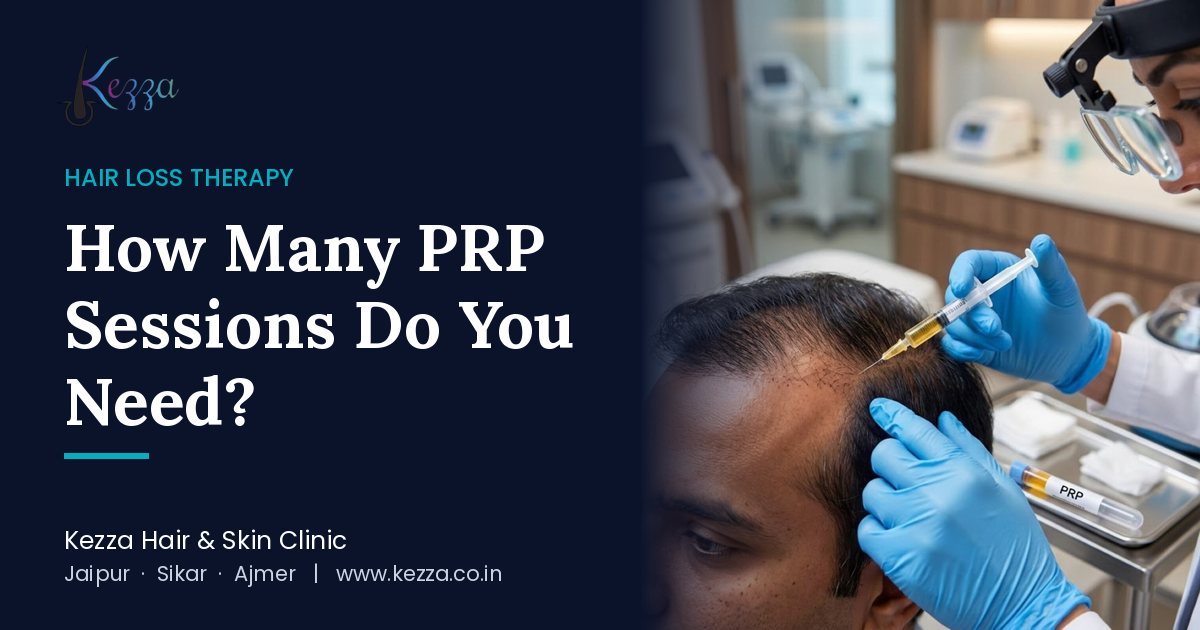
A session starts with a small blood draw. While your sample is prepared, the scalp is numbed; the injections themselves take about 10 minutes, and most people go straight back to their day. Keep the scalp dry for 24 hours, then wash with a mild shampoo. Your doctor tracks progress with photos and trichoscopy at each review. See our PRP and GFC therapy page for details, or book at our Jaipur or Sikar clinic.
Sources
- American Academy of Dermatology: Hair loss diagnosis and treatment
- Cleveland Clinic: Hair loss got you down? Platelet-rich plasma may regrow it
- Choubey et al. (2026). GFC versus PRP in androgenetic alopecia: a randomised controlled trial. Journal of Cutaneous and Aesthetic Surgery
- Alahmadi et al. (2026). Growth factor injection in androgenic alopecia: systematic review and meta-analysis. Aesthetic Plastic Surgery
This article is general health information, not a diagnosis or a substitute for a consultation. Treatment suitability, number of sessions and results vary from person to person; please speak to a doctor about your own situation.

Kezza Hair & Skin Clinic is a doctor-led hair, skin and aesthetics clinic with branches in Jaipur, Sikar and Ajmer. Meet our doctors. Related treatments: PRP & GFC therapy in Jaipur · Hair loss treatments