Key takeaways
- The Norwood (Hamilton–Norwood) scale grades male pattern hair loss from stage 1, with no recession, to stage 7, where only a horseshoe of hair remains at the sides and back.
- Stages 1 to 3 usually call for monitoring and medical therapy; transplants are typically considered once loss is stable and the donor area is good.
- Graft needs rise with each stage, and at stages 6 and 7 the donor supply, not the budget, is usually the limit.
- Women's pattern hair loss looks different and is graded on the Ludwig or Savin scales.
The short answer
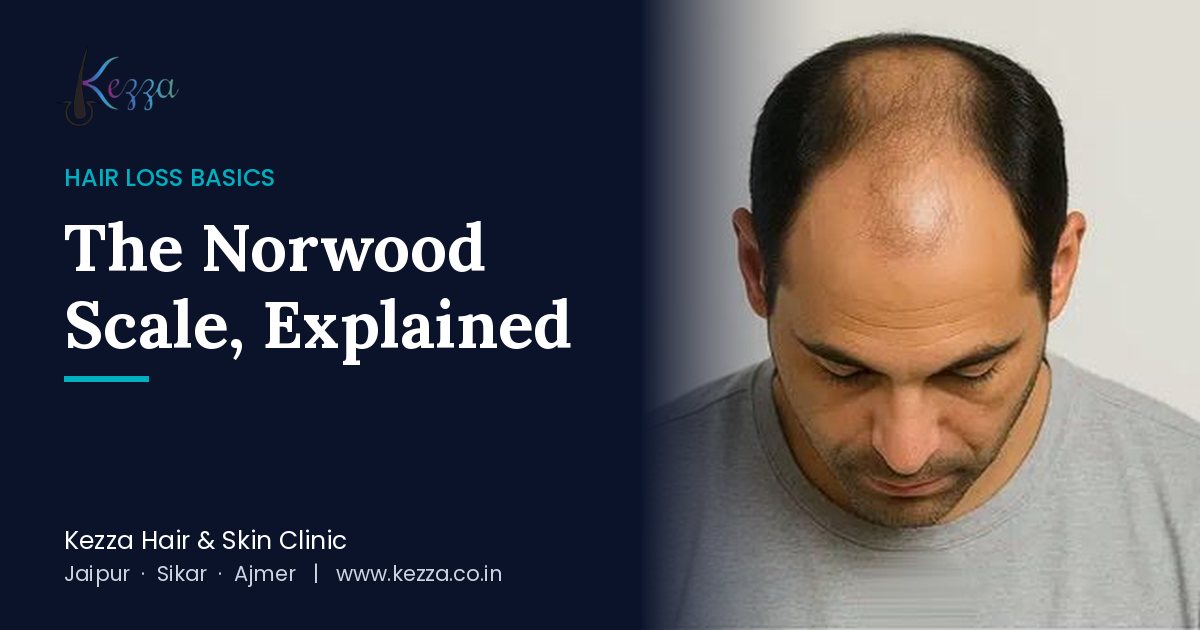
The Norwood scale, also called the Hamilton–Norwood scale, grades male pattern hair loss in seven stages. Stage 1 is a full hairline with no real recession; stage 7 leaves only a horseshoe-shaped band of hair around the sides and back of the head. In between, hair loss spreads from the temples and the crown until the two areas meet. Doctors use the stage to describe your hair loss, estimate how many grafts a transplant would need and decide which treatments make sense.
What the Norwood scale is
American dermatologist James Hamilton first described patterns of male baldness in the 1950s. In 1975, O'Tar Norwood revised and expanded the system in the Southern Medical Journal, and his version is the one most doctors use today. It has seven main stages, a "vertex" variant of stage 3 for men whose loss starts at the crown, and a "type A" variant in which the hairline recedes straight back from the front without a separate bald spot on the crown.
The scale is a description, not a diagnosis. Different examiners can grade the same scalp slightly differently, and other conditions, such as alopecia areata or thyroid-related hair fall, need to be ruled out. That is why a doctor's examination, ideally with trichoscopy, is more reliable than self-assessment.
The Norwood stages at a glance
These simplified top-down diagrams show the head from above, with the face at the top. Skin-coloured areas show where hair has been lost.
Stage by stage: what you see and what usually helps
| Stage | What you see | Approach doctors usually consider |
|---|---|---|
| 1 | Full hairline, no significant recession | No treatment needed; monitor if there is a family history |
| 2 | Slight, symmetrical recession at the temples (often called a mature hairline) | Monitor; start medical therapy if it is progressing |
| 3 | Deep recession at the temples; the first stage usually counted as balding | Medical therapy, PRP or GFC; hairline transplant once loss is stable |
| 3 vertex | Stage 3 hairline plus thinning at the crown | As for stage 3, with attention to the crown |
| 4 | Larger frontal loss and a bald crown, still separated by a band of hair | Transplant plus medical therapy to protect native hair |
| 5 | Front and crown areas larger; the band between them is thin | Larger transplant, often planned in two sessions |
| 6 | The band is gone; front and crown merge into one area | Transplant focused on the front and top, limited by donor supply |
| 7 | Only a narrow horseshoe of hair remains at the sides and back | Partial restoration to frame the face; scalp micropigmentation or hair systems |
How many grafts might each stage need?
Surgeons often start from rough ranges like these for men with pattern hair loss: about 1,500 to 2,500 grafts at stage 3, 2,500 to 3,500 at stage 4, 3,500 to 4,500 or more at stage 5, and 4,000 to 6,000 or more at stages 6 and 7. At stage 2, surgery is rarely recommended.
These numbers are only approximations. Donor density, hair thickness, curl, scalp size and the density you want all change the plan. From stage 6 onwards, the amount of donor hair, not the budget, is usually the limit, so full coverage may not be possible and the plan concentrates on the areas that frame your face. Read more about what decides the cost of a transplant.
When is a hair transplant a good idea?
There is no single "right" stage. The International Society of Hair Restoration Surgery describes good candidates as people whose hair loss has been stabilised with medical therapy, who have good donor hair and who have realistic goals, and it notes that older patients are often better candidates because their pattern is clearer. In practice, transplants are usually considered from stage 3 onwards, once hair loss is no longer changing quickly. Younger men with early loss are often advised to start medical therapy first. See FUE vs DHI for how the technique is chosen.
What about women?
The Norwood scale is designed for men. Women's pattern hair loss usually looks different: the front hairline stays in place while hair thins diffusely over the top of the head and the parting widens. Doctors grade it with the Ludwig or Savin scales instead. Medical therapy and PRP or GFC are common first steps, and transplants are considered in selected cases.
Treatment options by stage, in brief
- Medical therapy: minoxidil and finasteride, prescribed by a doctor. The American Academy of Dermatology notes that minoxidil usually takes 6 to 12 months to show regrowth, and finasteride about 4 months to show improvement.
- PRP or GFC: injections of growth factors from your own blood, most useful in early and active thinning. Read PRP vs GFC and how many sessions you need.
- Hair transplant: moves DHT-resistant follicles from the back and sides to the thinning areas; most useful from stage 3 onwards.
- Non-surgical options: hair systems and scalp micropigmentation can help at advanced stages, when donor hair is limited.
How to find your stage
Take clear photos of your hairline from the front, the temples from each side and the crown from above, in good light with dry hair. Compare them with the diagrams above, but treat the result as a rough guide. For a quick preliminary check, try our free AI skin and scalp scanner. For an accurate grade and a plan, book a consultation with trichoscopy at our Jaipur, Sikar or Ajmer clinic.
Sources
- Norwood OT (1975). Male pattern baldness: classification and incidence. Southern Medical Journal 68(11):1359–65
- ISHRS: FUE hair transplant, process, recovery and candidacy
- Charles Medical Group: Norwood scale assessment and graft estimates by stage
- American Academy of Dermatology: Hair loss diagnosis and treatment
- Wikipedia: Hamilton–Norwood scale (history and reliability)
This article is general health information, not a diagnosis or a substitute for a consultation. Treatment suitability, number of sessions and results vary from person to person; please speak to a doctor about your own situation.

Kezza Hair & Skin Clinic is a doctor-led hair, skin and aesthetics clinic with branches in Jaipur, Sikar and Ajmer. Meet our doctors. Related treatments: Hair transplant in Jaipur · Hair loss treatments