Key takeaways
- Hair-removal lasers target melanin, the pigment in dark hair. White and grey hair has little or no melanin, so it doesn't absorb enough laser energy to be damaged.
- Blonde and red hair also respond poorly, for the same reason.
- Electrolysis works on any hair colour because it treats each follicle directly with a fine probe and a small current. The US FDA describes it as a permanent hair removal method.
- Electrolysis needs several sessions. At Kezza most patients need 6 to 12, spaced 4 to 8 weeks apart, depending on the area.
The short answer
Laser hair removal works by heating the pigment (melanin) in dark hair. White and grey hairs have little or no melanin, so the laser has nothing to target and the follicle is not damaged. Blonde and red hair respond poorly for the same reason. The method that does work on white and grey hair is electrolysis, which treats each follicle directly with a very fine probe and a small electrical current, whatever the hair colour.
How laser hair removal works
Laser hair removal is based on a principle called selective photothermolysis: a specific wavelength of light is absorbed by a specific target, heating it while leaving the surrounding skin largely unharmed. For hair removal, the target is melanin in the hair shaft and follicle. The absorbed energy turns into heat and damages the follicle's ability to grow hair.
That is why laser works best when there is a clear contrast between dark hair and lighter skin, and why most people need about 4 to 8 sessions. In the US, the FDA allows lasers to claim "permanent hair reduction", meaning a long-term, stable reduction in the number of hairs that regrow, rather than removal of every hair.
Why white and grey hairs don't respond
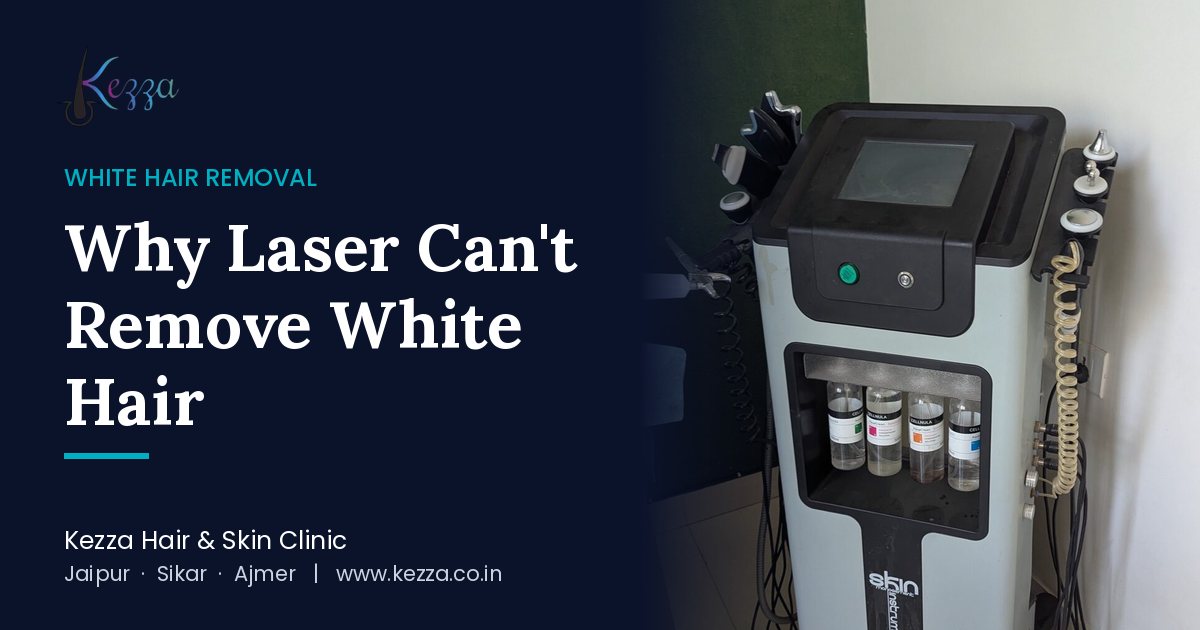
As hair turns grey and then white, the follicle stops producing melanin. Without pigment, the laser's light passes through the hair instead of being absorbed, so the follicle never heats up enough to be damaged. It does not matter which laser is used: diode, Nd:YAG, alexandrite and IPL devices all rely on melanin.
Why not just turn up the power? With no pigment in the hair, the extra energy has nowhere useful to go. Higher settings mainly increase the risk of burns, blisters and pigment changes in the skin, which is a particular concern in darker Indian skin tones.
What about blonde, red or fine hair?
Mayo Clinic notes that blonde, white and grey hair have less pigment, so laser is less effective, and that red hair contains a different type of melanin that does not absorb enough laser energy. Very fine, light hair often responds poorly too. For these hair types, electrolysis is usually the more reliable option.
Electrolysis: the option that works on white hair
Electrolysis treats hairs one at a time. A very fine, sterile probe is slipped into the natural opening of the hair follicle, and a small, controlled current is delivered to the root. This damages the follicle's growth centre so it cannot produce a new hair. Because it does not depend on pigment, it works on white, grey, blonde and red hair, and on any skin tone.
The US FDA describes electrolysis as a permanent hair removal method, since it destroys the hair follicle. It still takes several sessions, because hairs grow in cycles: at any one visit, only some follicles are in the active growth phase when treatment is most effective, and new hairs surface over the following weeks.
Laser vs electrolysis at a glance
| Laser hair removal | Electrolysis | |
|---|---|---|
| Works on white or grey hair | No | Yes |
| How it works | Light heats melanin in the hair | Probe and current treat each follicle directly |
| Speed | Treats many hairs at once | One hair at a time |
| Best for | Large areas of dark hair | White, grey, blonde or red hair, and small areas |
| Result | Long-term reduction | Permanent removal of treated hairs |
What to expect from electrolysis
- Before: a numbing cream is usually applied to the area beforehand.
- During: most people feel warmth or a brief pinch with each hair.
- After: mild redness or small bumps usually settle within hours to a day. Avoid scrubbing, heavy makeup and sun on the area for a day or so, as your doctor advises.
- Safety: the FDA notes that risks include infection from an unsterile needle and scarring from improper technique, which is why electrolysis should be done with sterile, single-use probes by trained staff.
Common areas we treat
- White hairs on the upper lip, chin and jawline
- Grey hairs in the eyebrows or sideburns
- White hairs scattered through the beard line
- White hairs regrowing in a transplanted area after a hair transplant
White hair removal at Kezza
Our doctor-led electrolysis protocol, Kezza Medline Micro-Epilation, starts with a trichoscopy map of the area so each follicle can be targeted. Most patients need 6 to 12 sessions spaced 4 to 8 weeks apart, with small areas clearing sooner. If you already have laser treatment for dark hair, we can plan electrolysis for the white hairs it cannot reach. Book at our Jaipur clinic or ask about the clinic nearest you.
Sources
- US FDA consumer update: Removing hair safely (via Drugs.com)
- Mayo Clinic: Laser hair removal
- Wikipedia: Laser hair removal (selective photothermolysis and the FDA definition of permanent hair reduction)
This article is general health information, not a diagnosis or a substitute for a consultation. Treatment suitability, number of sessions and results vary from person to person; please speak to a doctor about your own situation.
Kezza Hair & Skin Clinic is a doctor-led hair, skin and aesthetics clinic with branches in Jaipur, Sikar and Ajmer. Meet our doctors. Related treatments: White hair removal in Jaipur · Laser treatments